
Do you know about Dai Baos? Learn how to make these large steamed fluffy buns filled with ground pork, pieces of chicken, Chinese sausage, and half of a hardboiled egg. It’s Chinese dim sum item that is a hearty handheld meal all by itself.
Disclaimer: Please check that all ingredients are suitable for your allergies and be sure to ask your medical care team regarding any allergy related questions (I do not share medical advice). As an Amazon Associate, I earn from qualifying purchases.
What are Dai Baos?
My parents used stop at either a Chinese bakery or a dim sum take-out store to buy dai baos (大包). Dai baos means “big buns” in Cantonese. Some people might refer to them as dai gai bao (大雞包) which means “big chicken buns.” You might see them on an English menu as chicken combination bun, which hints at the ingredients but doesn’t tell me that they’re big. I look for the Chinese characters 大包 on the menu.
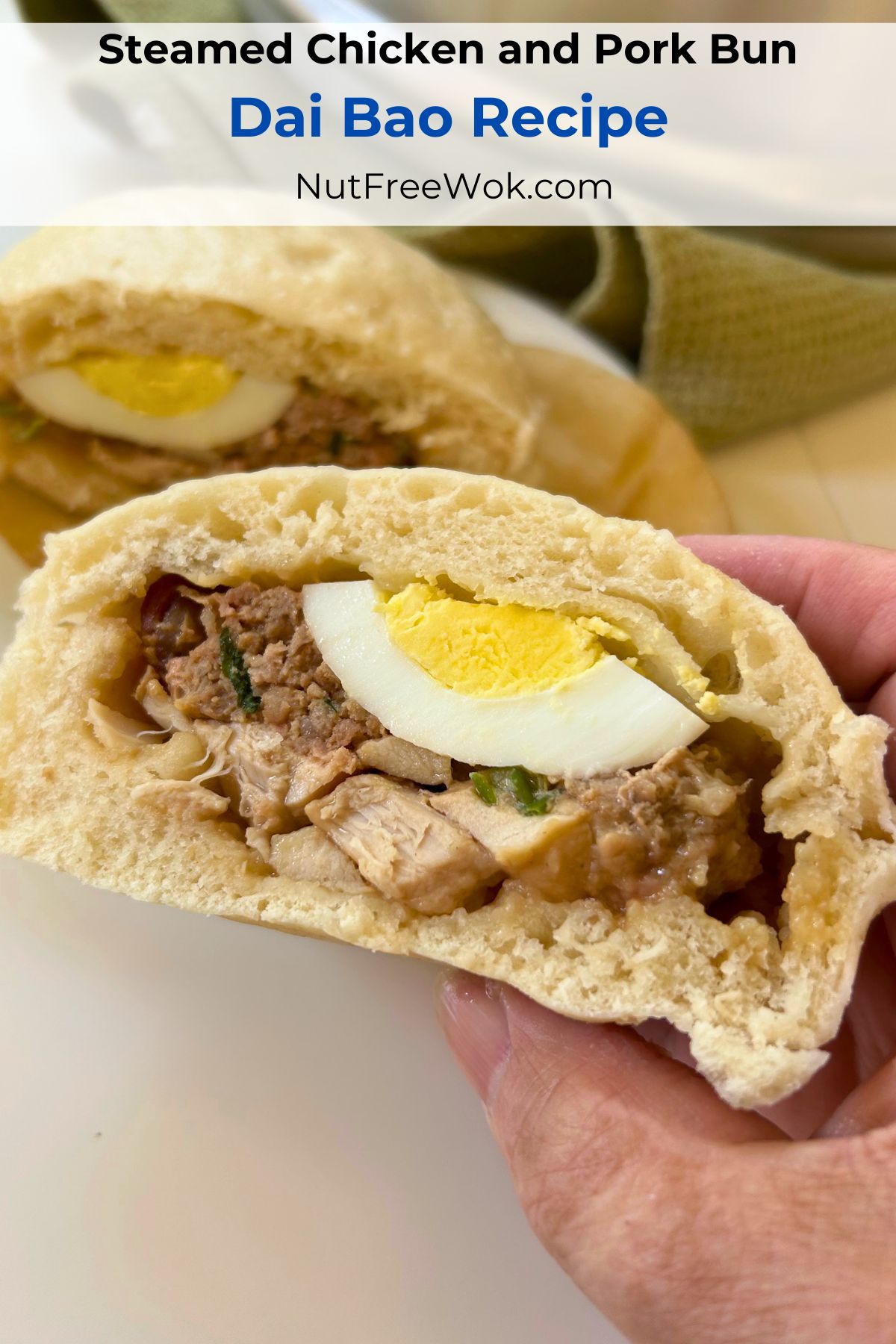
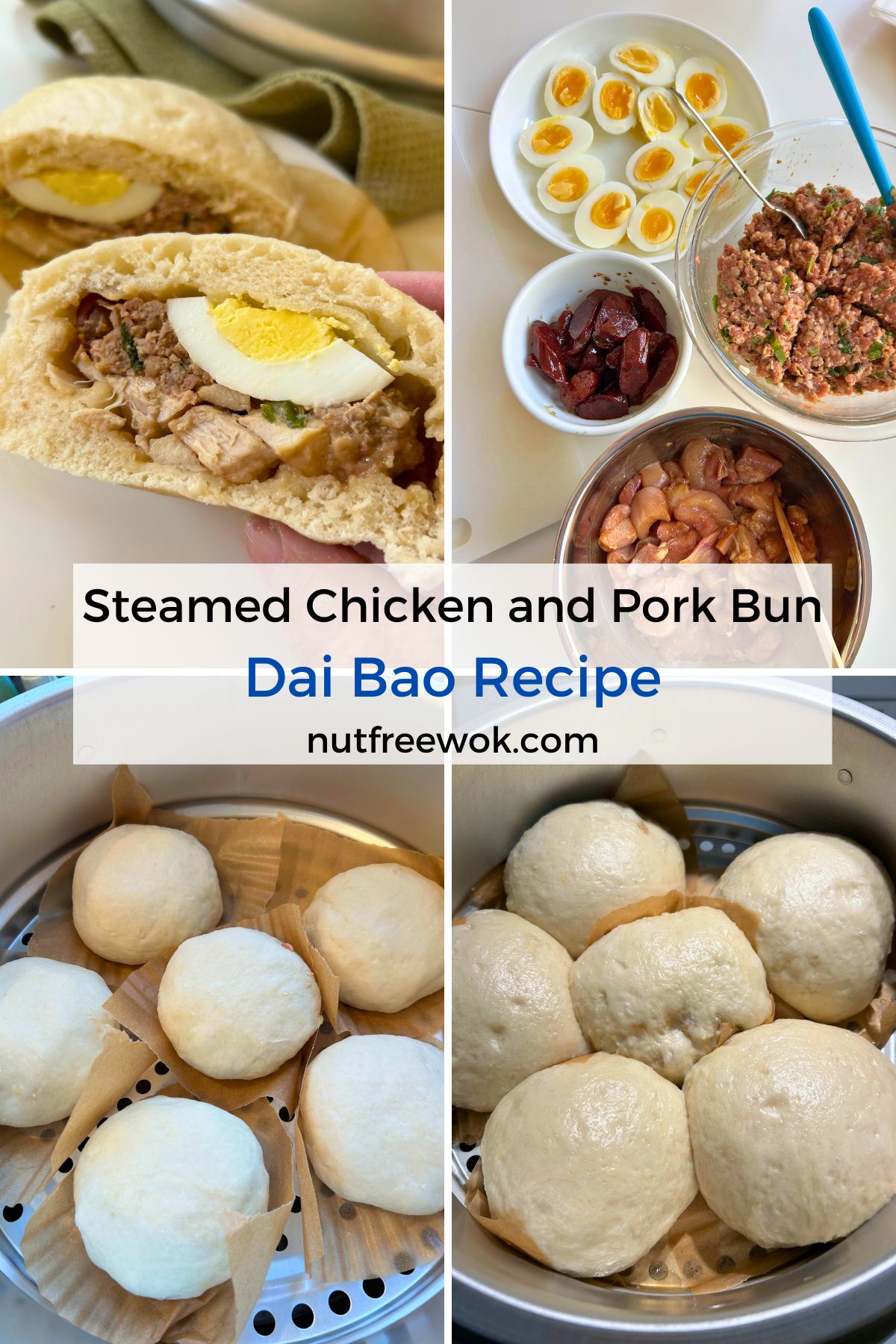
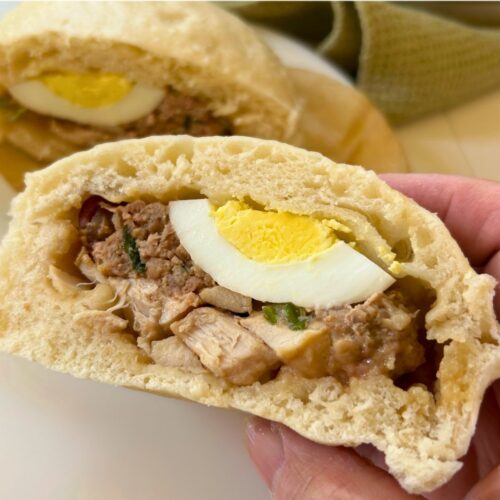
These fluffy steamed buns have ground pork, a piece of chicken, a piece of Chinese sausage, half of a hardboiled egg, and half of a shiitake mushroom. That’s a lot of filling which is why the buns are huge.
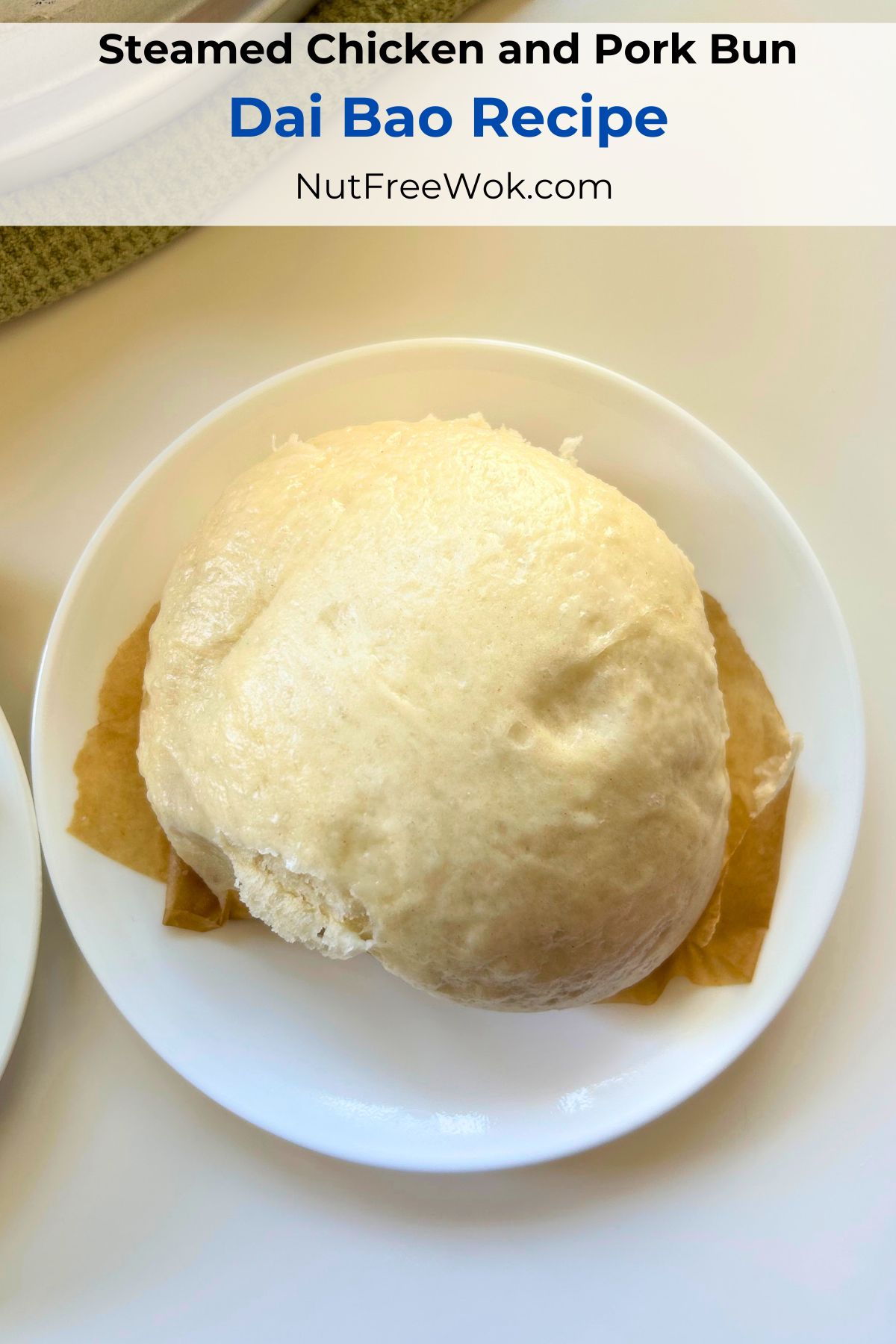
You can recognize the baos when you see a large white steamed bun that’s bigger than a bagel. They’re seldom wrapped with fancy pleats because it’s a feat to wrap them.
Ingredients to Make Dai Baos
My no-knead char siu bao recipe has a dough recipe that is easy to make and super fluffy. I decided to double the dough ingredients but make 16 dai baos so that they’re 50% bigger. I liked that batch, but the baos were not big enough. This recipe makes 12 baos that are twice as a big as my steamed char siu baos.
Ground Chicken vs. Ground Pork
It’s more typical to use ground pork than ground chicken but since I personally prefer eating chicken more than pork, I made my first few recipe tests with ground chicken, so flavorful and tender.
I also made a batch with ground pork. The ground pork seemed crumbly and needed a lot of stirring, and I added an egg as a binder. The ground pork was good but I opted for a more traditional recipe. Feel free to swap out ground pork and use ground chicken if you prefer.
Sliced Chicken Thighs
I remembered that dai baos also have a piece of chicken. In my last test batch, I added pieces of sliced and marinated chicken thighs, which I enjoyed eating. My son observed that he liked the different textures.
Soft Boiled Egg
I use my Instant Pot to make some soft boiled eggs. The egg whites are solid but the yolk is still a bit runny. When I put them into the dai baos, the eggs are steamed until they’re cooked. I think if I put a hard boiled egg into the dai bao, the egg yolk might become too hard and crumbly after steaming.
In case you don’t have an Instant Pot, I steamed some eggs for 9 minutes. The egg whites were set but the yolk was slightly runny. Steaming eggs for 9 minutes will give you a soft-boiled texture. You could probably steam them for 10 minutes and it would be fine.
Lap Cheong (Chinese Sausages)
Lap cheong are Chinese sausages that are filled with cured meats and dried until they are firm. You can buy them at Asian grocery stores, usually packaged in vacuum sealed plastic bags. I recommend checking the ingredient labels. The sausages contain soy sauce, so soy and wheat are the usual allergens to check. Store bought options are difficult to confirm about potential cross-contact with other allergens.
Another alternative is to buy them from a local mom and pop Chinese cured and dried meat shop, where you can talk with someone about the ingredients. Mow Lee is located in San Francisco’s Chinatown and they ship to all 50 states.
You can buy lap cheong in a variety of flavors besides pork. My favorite lap cheong is Kam Yen Jan made with pork and chicken but sometimes I will buy Kam Yen Jan pork sausages from Costco when they have a sale.
Dried Shiitake Mushrooms (if using)
Dai baos also have shiitake mushrooms but I left them out due to my son’s allergy to mushrooms. If you want to add shiitake mushrooms, rehydrate them overnight in your refrigerator for best results. Remove the stem and then cut them in half or slice them into four pieces. You can saute them with the lap cheong when preparing the filling.
How to Make Dai Bao
Dough Tips
The fluffiness of this recipe relies on the effectiveness of yeast and baking powder. Check that the water for the yeast is warm, not hot. If you accidentally use too much hot water, add an ice cube.
Also check that your baking powder is still fresh and effective. I like to stir in a small amount of baking powder into a glass of water to see that the baking powder will fizz in the water.
This no-knead bao dough is easy to make and it’s better to err on wet and shaggy than dry and stiff. To be sure I have the right ratios, it’s important to measure the water and flour ingredients accurately.
- When I measure water for the yeast, I set the measuring cup on the counter and when the water level stops moving, I bend down to eye level and check that the meniscus (water line) is at the desired mark.
- Also, I fluff up the flour by scooping and dumping it back into the bag a few times and then I scoop and level.
Filling Tips
To manage your time, you have the option to make all of the filling items in advance and refrigerate overnight.
- Soft boiled eggs: make the eggs, peel, cut in half, cover, and refrigerate.
- Chicken thigh: marinate the sliced chicken in a storage container, cover with a lid, and refrigerate.
- Lap cheong slices: saute and season, refrigerate overnight in an airtight storage container.
- Ground pork: combine the filling ingredients and refrigerate in an airtight storage container.
Final Preparations
Take the filling ingredients out of your refrigerator about 30 to 45 minutes before you want to start assembling the baos. This allows the ingredients to come to room temperature. If the filling ingredients are too cold, then the assembled baos will not proof as well.
Prepare your parchment paper before you start assembling the baos. You can use parchment paper cupcake liners that you can flatten or cut a large piece from a roll of parchment paper into 4-inch squares. I have some parchment paper air fryer liners and I just cut or tear them into quarters.
Make the dough balls
After the dough rises, you will want to divide the dough into 12 pieces. Take each cut piece, stretch lengthwise and fold the top and bottom ends on top of each other. Then stretch widthwise and fold the left and right sides on top of each other and roll into a ball.
By the time I finish all 12 pieces of dough, the first dough ball is relaxed and ready to shape. Take one of the dough balls and flatten it slightly and stretch the edges out a little bit but leave the center a little bit thicker. If your dough circle bounces back, it needs a few more minutes to relax.
Assembly Tips
I like that every bite of a dai bao is a little bit different. For this reason, I like to assemble my bao in a specific order. Put the cut soft-boiled egg half yolk-side down first, add two spoonfuls of ground meat around it, and place slices of lap cheong on the sides and the slices of chicken on top, so that every bite of a steamed bao will be varied. I lay out my containers of filling in a row so that I don’t leave any filling ingredients out.
After you add all of the filling ingredients, it might look impossible to wrap the dough with the tiny bit of margin left but you can do it.
- Cup your hand that is holding the dough and filling and stretch the top and bottom sides of the dough (12 o’clock and 6 o’clock positions) and pinch, then grab the left and right sides of the dough (9 o’clock and 3 o’clock positions) and pinch.
- Then dip your fingers in some flour and pinch the rest of the edges together, rotating the bao in your cupped hand while giving the bao a gentle squeeze to round out all the filling at the same time.
- Place the shaped bao seam-side down on a piece of parchment paper and place that in your steamer basket. When all the baos are assembled, cover them with a lid or a clean dish towel to proof for 30 minutes in a warm spot.
Set Up a Steamer
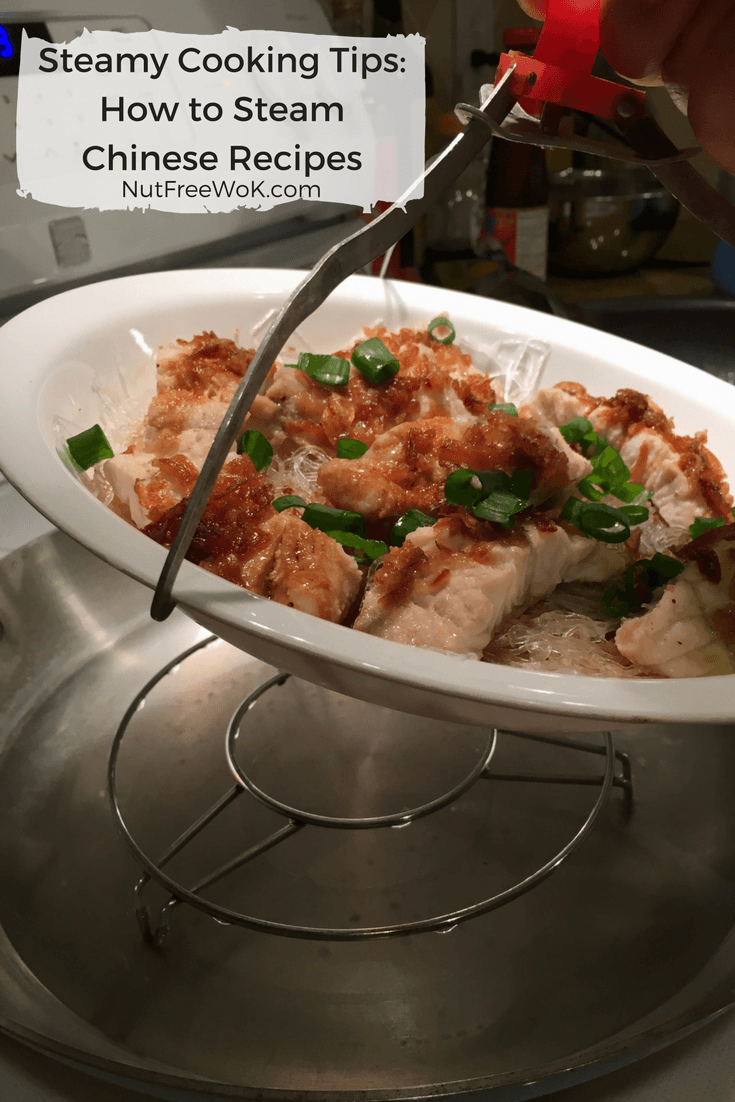
While the baos are proofing, I set up a steamer. I have a large 14-inch wide three-tier steamer with a deep pot that can boil enough water for 30 minutes on medium high heat. The two steam layers are wide enough to steam all 12 baos at once.
It looks very similar to this lightweight aluminum steamer. I have been looking for a steamer made with stainless steel but they’re usually 10-12 inches wide which would be less roomy than the 14-inch steamer that I’m used to. You might be able to steam in a 12-inch 3 tier steamer by setting up a tall steam rack and steamer basket in the pot, along with the two other layers.
If you have an electric food steamer, that is a great option as long as they’re deep enough for these hefty dai baos and that you allow enough room around the baos for the steam to circulate through the layers.
Options for using a stock pot as a steamer
Because it takes 30 minutes to steam each batch of baos, you will need about 2 inches (or more) of water in the pot. If you you use a 6-8 quart stock pot, check that the pot is 5-6 inches deep to allow room for the water, an additional 2 inches for the baos and an inch of clearance for the steam and lid. You will also need a steam rack to elevate your plate or steamer basket.
The most traditional way to set up a steamer using a stock pot is to use bamboo steamer baskets. Measure the width of your pot and buy a bamboo steamer that is the same width so that it will rest on top of your stock pot without dripping condensation. It’s important that after you use bamboo steamers, wash them and dry them thoroughly.
Allergy Aware Dai Baos
This recipe for dai baos is free of peanuts, tree nuts, milk, shellfish, and sesame as written. Dai baos are typically a peanut and tree nut free item but store bought dai baos might have milk in the dough, oyster sauce and/or sesame oil as seasoning.
They also will use shiitake mushroom which is my main reason for making homemade dai bao without mushrooms due to my son’s allergy. I’ve included instructions on how to prepare the mushroom filling in the recipe notes.
It’s also easy to make the baos egg-free by not including the soft boiled eggs. Just replace the egg with more of the other filling ingredients.
To replace the egg used as a binder in the ground pork filling, try adding an equivalent amount of water and stir vigorously until the ground meat becomes a paste and/or sticks together.
If allergic to soy, use my recipe for soy-free soy sauce or season with salt or chicken bouillon and omit the Chinese sausage and replace with more of the other ingredients.
It would be possible to make the dough with 1:1 gluten-free, wheat-free flour mixes. However, I can’t test all the different mixes so I recommend that you experiment. The next time you make some gluten free bread, reserve some dough and steam it. Does it look and feel like bread? You will also want to swap out the soy sauce with a gluten-free tamari and find an alternative ingredient for the Chinese sausage.
Dai Bao Recipe (Steamed Pork and Chicken Buns)
Equipment
- 1 large steamer
Ingredients
Dough ingredients
- 2 cups water warm (105°F to 110°F)
- 2 packets yeast 4.5 teaspoons
- 1/2 cup sugar granulated
- 4 1/2 cups all purpose flour plus 2-3 tablespoons for dusting later
- 1 1/2 cups cornstarch
- 2 tablespoons baking powder
- 1 teaspoon salt
- 4 tablespoons olive oil or other neutral oil plus more for the bowl
Filling ingredients
- 6 large eggs soft boiled
- 3 links lap cheong (Chinese sausages) pork and chicken, preferred
- 1 teaspoon olive oil
- 1 teaspoon sugar
- 1 teaspoon soy sauce
- 1 pound ground pork (or substitute with ground chicken)
- 1 large egg
- 1/4 cup chopped cilantro
- 1/4 cup chopped scallions
- 2 teaspoons soy sauce
- 1 teaspoon sugar
- 1/4 teaspoon ground white pepper
- 1 teaspoon cornstarch
- 2 pieces chicken thighs boneless, skinless (approximately 0.9 to 1 pound)
- 2 teaspoons soy sauce
- 1 teaspoon sugar
- 1 teaspoon cornstarch
Instructions
Dough Instructions
- Combine 1 1/2 cup room temperature water plus 1/2 cup hot water in a 2 cup measuring cup. Check that the temperature is between 105°F to 110°F and adjust accordingly. Add the yeast and sugar and stir to combine. Set aside for 10 minutes until the yeast mixture is foamy.
- Combine the flour, cornstarch, baking powder, and salt in a large mixing bowl and make a well in the center. Pour in half of the yeast mixture into the well and stir while gradually incorporating the flour. Add the remaining yeast mixture and 4 tablespoons olive oil and continue to stir until a shaggy dough forms.
- Use a rounded dough scraper to scrape down the sides of the bowl and to incorporate the rest of the flour in the bowl. If there’s a lot of flour, check to see if there are extra drops of oil or yeast in your measuring spoons or cups to add to the bowl. Continue to use your dough scraper or use your hands to knead the dough a few times in the bowl until it’s smooth.
- Drizzle about a tablespoon of oil around the bowl to coat the bowl, use the dough scraper to flip the dough over. Cover with plastic wrap or a large dinner plate and allow the dough to rise in a warm place for 60 minutes until doubled in size. If needed you can allow the dough rise up to 90 minutes if it's a cold day, you are busy, filling prep takes longer than expected, etc..
Filling Instructions
- Eggs: You will need 6 soft boiled eggs. I recommend making more in case some of them crack. You can either cook them in an instant pot or steam them on a rack in a covered pot for 10 minutes and then put them in an ice water bath for 10 minutes. Peel the eggs, cut in half, wrap with plastic wrap, and refrigerate until ready to fill the baos.
- Chinese Sausage: Slice each Chinese sausage on a bias (diagonally) into 8 pieces. Add the Chinese sausage into a cold frying pan and cook on low-medium heat for 3-4 minutes until the sausages releases some fat, stir-fry and flip each piece to cook on the other side. Add 1 teaspoon oil and 1 teaspoon of sugar into the pan and stir fry for 30 seconds. Turn the heat off, add 1 teaspoon soy sauce, and stir fry until the sauce carmelizes and coats the sausage slices. Transfer to a bowl to cool until ready to fill the baos.
- Ground Pork: Place ground pork in a medium sized mixing bowl. Add 1 raw egg, 1/4 cup chopped cilantro, 1/4 cup chopped scallions, 2 teaspoons soy sauce, 1 teaspoon sugar, 1/4 teaspoon ground white pepper, and stir until well-combined. Add 1 teaspoon cornstarch and continue to stir until the ground pork mixture sticks together, like a paste. Cover with plastic wrap and refrigerate until ready to fill the baos.
- Chicken Thighs: Use scissors or a sharp knife to trim the excess fat from the chicken thighs. Cut each thigh in half lengthwise and cut each half into 6 pieces cross-wise. Place the chicken slices into a medium sized mixing bowl and add 2 teaspoons soy sauce and 1 teaspoon sugar, and stir. Add 1 teaspoon corn starch and stir some more. Cover with plastic wrap and refrigerate until ready to fill the baos.
Bao Assembly Instructions
- Set up your bao assembly area. Take the filling ingredients out of the refrigerator and lay them out in a row from left to right, eggs, ground pork, Chinese sausage, and chicken thighs with necessary spoons or forks for scooping. Cut parchment paper into 4 inch squares, set aside. Gather your steamer baskets nearby to place your baos for proofing. Scoop 2-3 tablespoons of flour into a small bowl for flouring your work surface and fingers.
- Divide and shape the dough. Place a large cutting board on your work surface and lightly dust it with flour. Dust a rounded dough scraper with flour and use it to scrape the dough onto the floured cutting board. Use floured hands to shape the dough into a rectangle and cut it into 12 pieces (3×4).
- Take one of the pieces and stretch it lengthwise and fold the top and bottom ends to the center. Then stretch the dough sideways and fold the left and right sides to the center. Roll the dough into a ball, set aside and repeat with all 12 pieces.
- Slightly flatten one of the dough balls slightly and stretch the edges into a 5-inch circle, thick in the center and thin at the edges. If the dough bounces back, allow it to rest a few more minutes and work with a different piece.
- Fill the dough. Place the dough circle on a floured and cupped hand, place half of a soft boiled egg yolk-side down on the center of the dough. Use a tablespoon to scoop approximately two tablespoons of ground pork and place a tablespoon on each side of the egg. Add two slices of Chinese sausage on each side of the pork. Place two pieces of sliced chicken thighs on top of the pork. Cup your hand holding the dough and filling slightly and gather the top and bottom edges of the dough circle (12 and 6 o’clock) and pinch. Gather the left and right edges of the dough circle (9 and 3 o’clock) and pinch. Gently gather and pinch the remaining edges together until the bao is sealed. If the edges separate and won’t pinch together, dip your fingers into the extra flour and pinch again. Place the filled bao seam-side down on a piece of parchment paper and place bao lined with parchment paper in a steamer basket.
- Repeat with the remaining pieces of dough balls and fillings. Arrange the filled baos in the steamer basket with about 1 inch of space between the baos. Cover the baskets with a lid or a clean towel and allow the baos to proof for 20 to 30 minutes in a warm place.
Steam the Baos
- In the meantime, set up your steamer (see the post for more detailed instructions). Fill a large pot with at least 2 inches (preferably 3 inches) of water, cover with a lid, and bring to a boil on low-medium heat.
- When the baos are done proofing, change the heat to medium, check that there’s enough water in the pot, and that the water is boiling. Add the steamer baskets to the pot, cover with a lid, and steam for 25-30 minutes, until cooked through.
- When the baos are ready, carefully lift the lid without dripping water on the baos. You can check that the baos are cooked through by using a digital thermometer to check that they have an internal temperature of 165°F.
- Prevent soggy bao bottoms. Remove the steam baskets and place them on a kitchen towel on a slightly uneven surface so any excess water will drain out. Or transfer the baos onto a cooling rack for a few minutes. The baos are best served hot or warm.
- Allow any extra baos to cool to room temperature and then store in large zippered plastic bags or large storage boxes with a paper towel to absorb any excess moisture. Reheat by steaming for a few minutes or you can wrap with a damp paper towel and microwave for a minute.
Notes
Nutrition
Related Recipes:
I have other savory Chinese bao recipes such as steamed char siu baos as well as baked char siu baos. You may also like some sweet Chinese bakery or dim sum desserts such as my recipe for The Best Raisin Bread Recipe (Tangzhong Method).
If you need recipes that are top allergen free, you will want to take a look at my recipe for Baak Tong Gou, a Top 9 Allergen Free Chinese Dessert. Another recipe that is top allergen free is Easy Top 9 Allergen Free Banana Rolls Recipe.
Thanks for reading, please help Nut Free Wok!
If you like this post or recipe, please be sure to give a 5 star rating, leave a comment, and share this post! Your support means a lot to me.
Subscribe to Nut Free Wok’s email subscription (be sure to respond to the confirmation email). You will be notified by email next time I publish another post or recipe and I won’t send you spam or share your email address with anyone.
Disclosure/Disclaimer:
I may mention the names of stores and/or brand names of products that I use because readers ask and I share products and sources which I use and think may be helpful to readers, all opinions are my own. Please note that manufacturing practices and ingredients can change at anytime without notice and readers are always responsible for assuring allergen safety before buying or consuming foods. NutFreeWok.com is a participant in the Amazon Services LLC Associates Program, an affiliate advertising program designed to provide a means for sites to earn advertising fees by advertising and linking to Amazon.com. Thank you for reading!