
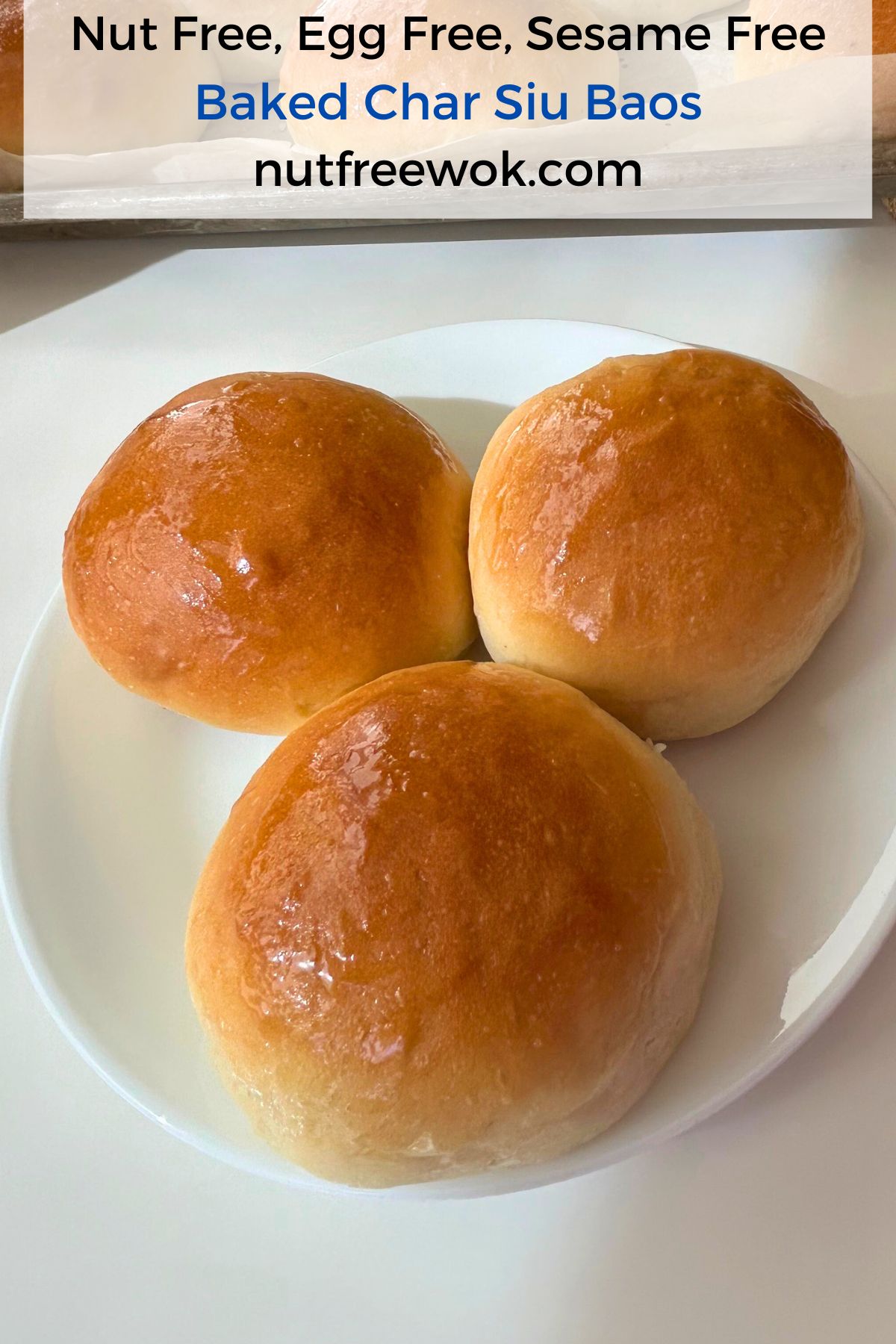
Learn how to make baked char siu baos, soft, fluffy buns filled with a sweet and savory Chinese BBQ pork filling that are nut-, egg-, and sesame-free. I recommend reading the entire post for all the tips and insights, but there’s a “jump to recipe” button below if you need it.
Disclaimer: Please check that all ingredients are suitable for your allergies and be sure to ask your medical care team regarding any allergy related questions (I do not share medical advice). As an Amazon Associate, I earn from qualifying purchases.
Dim Sum: Baked Char Siu Bao
Baked Chinese BBQ pork buns are called 叉燒餐包 char siu chaan bao, which means literally means “BBQ pork lunch bread.” I usually call them 焗叉燒包 guk char siu bao, which means baked BBQ pork bun.
When you eat at a Chinese dim sum restaurant, they may serve two different kinds of char siu baos. If you ask for char siu bao, a server will bring you basket of steamed char siu baos which will be a steamy hot white bun with the pieces of pork peeking visible in the cracks.
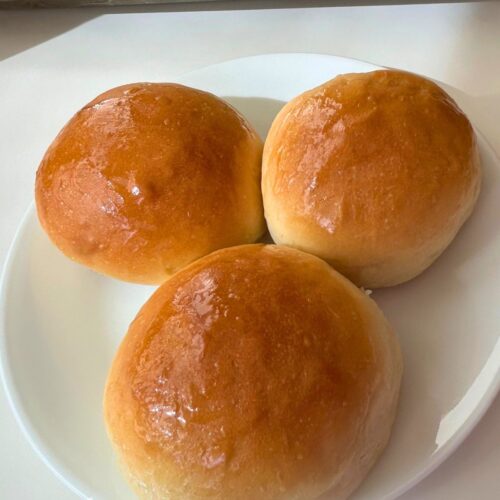
Some places might also serve baked char siu baos, in which case you will have to ask specifically for “guk char siu bao.” An order of baked char siu baos will be golden brown in color with a smooth, shiny appearance on the outside, but with no hints about what’s inside.
Baked char siu baos served at a dim sum restaurant are usually slightly smaller (dinner roll sized) and usually an order will be 3 baos served on a small plate. It’s fine that they’re small because people might eat half or one char siu bao as part of a larger dim sum meal.
However, baked char siu baos sold at a Chinese bakery are larger (bagel sized) and suitable for breakfast or a small lunch.
Unexpected Allergen
Peanuts and tree nuts are seldom ever an ingredient in Char Siu Baos in general, regardless of whether they’re baked or steamed. We have been able to order and eat char siu baos from restaurants or bakeries that handle food allergens well.
A new Chinese bakery opened in my city a few years ago and I was excited to have a local business to support. I liked their baked char siu baos but before buying more to share with the family, I followed up with the business about allergens. They told me they use peanut oil as an ingredient. Why???! How? It was a first and seemed so unnecessary. I had so many questions but the answers don’t matter since I wouldn’t buy them for my family.
While highly refined peanut oil might be safe for some people sometimes, it’s something we avoid because I don’t expect anyone to know for certain or guarantee that the peanut oil they use is safe for people with a peanut allergy. Peanut oil in baked char siu baos was truly a first for me and I had to cope with my disappointment, which made me want to share this recipe even more.
Baked Char Siu Bao Goals
Every dim sum restaurant and Chinese bakery makes baked char siu baos a little bit different and you can’t tell if it will taste good by looking at them until you bite into one to taste the texture of the bread and the quality of the filling.
Perfect bread
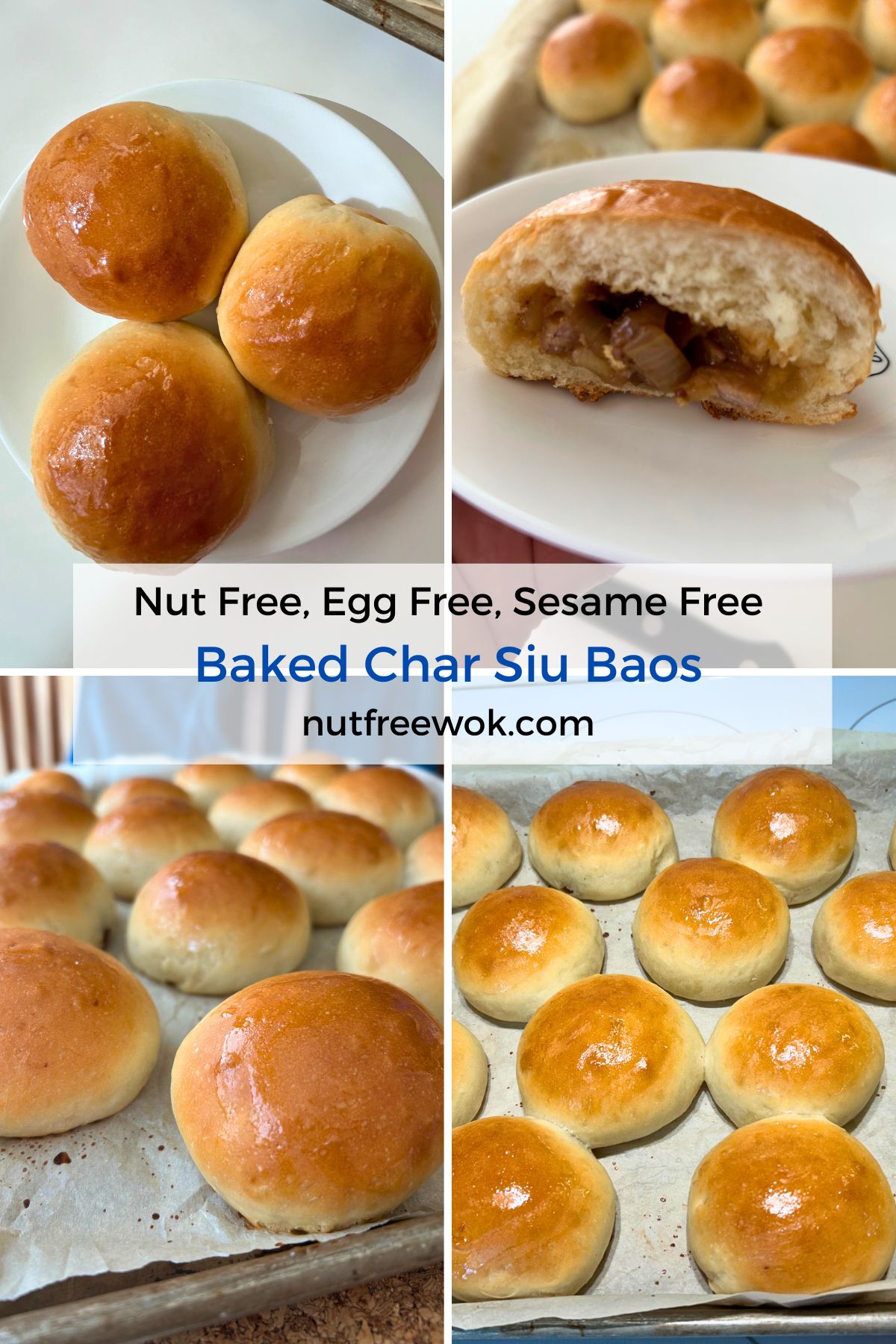
You want to see that the bao is lightly brown to golden brown. If it’s too browned, then it might be dry. The bao should also look shiny with a little bit of sweet stickiness.
The bread needs to be soft, maybe with a little bit of chew from great gluten formation. Sometimes they look great on the outside, but the inside is cavernous, with very little bread or filling.
Perfect filling
You want the first bite of char siu bao to taste sweet and savory at the same time. I recently bought some baked char siu baos with a filling that tasted sour, ai ya!
The filling needs to be meaty, not fatty. The char siu meat needs to be diced, not minced or filled with char siu flavored ground pork. I like the meat with just a little bit of sauce/gravy and lots of meat so that it’s hearty.
Recipe Testing Notes
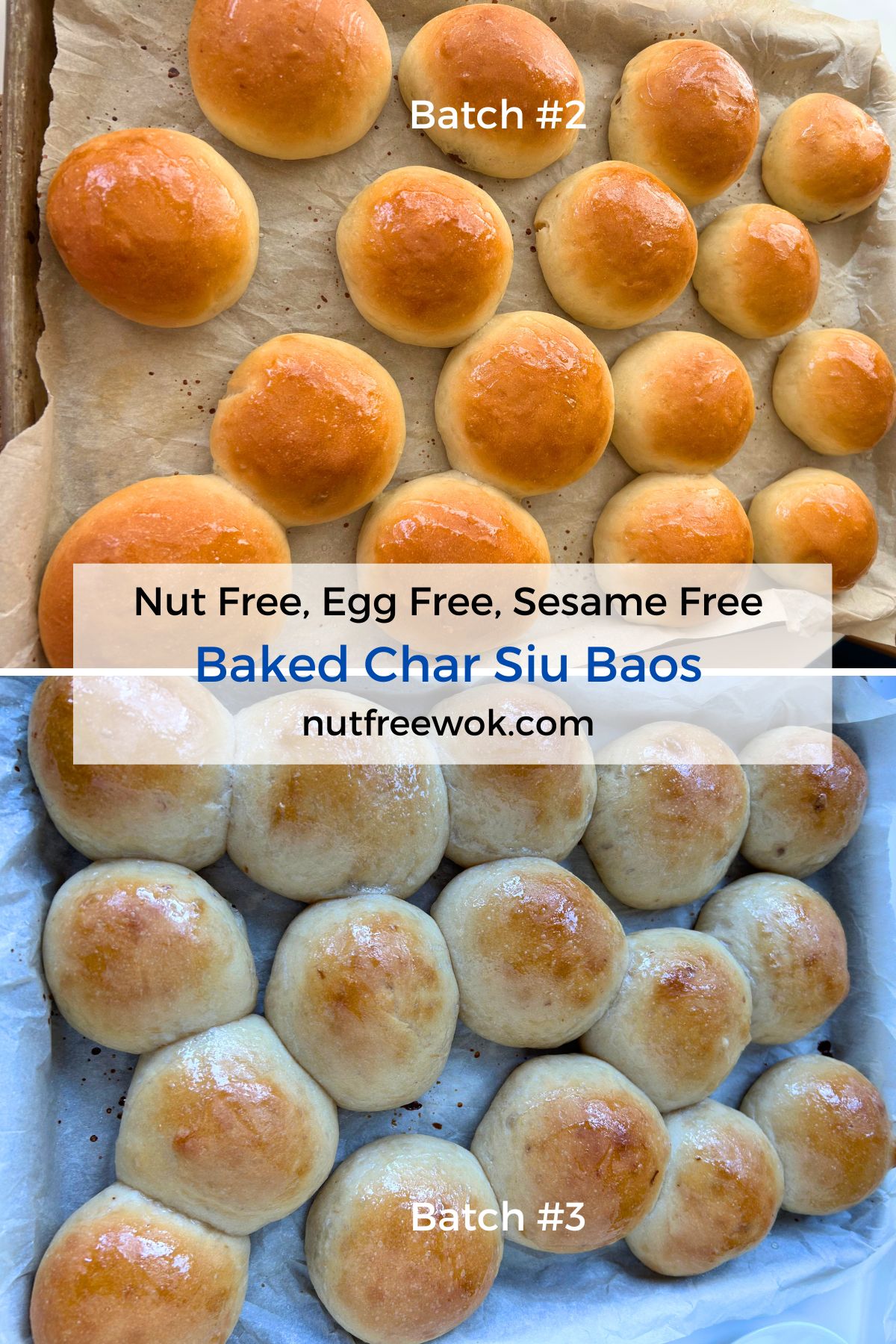
I used the tongzhou method from my raisin bread recipe and the filling from my steamed char siu bao recipe. I did not scale the recipe correctly and ended with a soggy dough and had to add more flour, which made for a stiff bread. The first batch tasted good for a first batch but there was room for improvement.
With a few recipe adjustments such as adding some butter to the dough and adjustments to the ratio of water to flour, the second batch looked like baked char siu baos served at restaurants and tasted great.
Since I still had enough homemade char siu for a third recipe test, I squeezed in another recipe test.
- I wanted to check if using 3.5 cups of flour in the dough was too much and could I get away with using 3.25 cups of flour? I set aside the remaining 0.25 cup and ended up using it in the dough and for shaping the baos.
- It was a busy workday and I ended up proofing the baos for 2 hours instead of 45 minutes. Yikes, I might have overproofed the baos. I was so surprised to see that the proofed baos were quite large. I would still recommend proofing the baos approximately 1 hour, plus or minus 15 minutes.
- Overall, this batch was even more soft and fluffy compared to the previous batches. I think you will be able to make a tasty batch of baos on the first try.
How to Make Egg-Free Baos
When we combine flour, water, yeast, and salt, we could make a nice crusty loaf of bread. But for a soft, dinner roll type of bread, we need to add fat and protein such as butter, milk, and eggs to enrich the flour. I decided to make the dough egg-free, simply by not including eggs in the dough or as an egg wash.
The hard part of making this recipe egg-free is to figure out how to apply an egg wash for browning right before baking without using eggs. I looked at vegan substitutions for an egg wash which recommend brushing with soy milk and maple syrup.
I didn’t want to buy a container of soy milk for an alternative egg wash. But since the recipe already uses milk, I decided to try brushing with milk and maple syrup, the baos were beautifully browned.
For the next batch, I brushed a few baos with just milk and then added a little bit of maple syrup to the milk and brushed the rest with milk and maple syrup. The baos brushed with only milk and the baos brushed with milk and maple syrup looked identical. The addition of maple has a minimal effect on browning, at least when combined with milk. I think the difference in browning between batch #2 and batch #3 was the total bake time.
My Baked Char Siu Bao Recipe is Sesame-Free Too!
My son used to be severely allergic to sesame before he outgrew his sesame allergy. I absolutely understand how hard it is to buy any breads that are sesame free.
My original char siu (BBQ pork) recipe is sesame free as common store bought char siu marinades or condiment ingredients might contain sesame. Also, it’s common for the BBQ pork filling to be seasoned with hoisin sauce and/or sesame oil and the baked BBQ pork buns might be topped with sesames, or prepared in the same facility.
If you need a sesame free recipe for baked char siu baos, allow extra time to make some homemade char siu.
Tangzhong to Hydrate Your Dough
If you have tried my recipe for Chinese bakery style raisin bread, you might already be familiar with the idea of making tangzhong 唐中 to hydrate your dough. Tangzhong bread will be soft and stay fresh longer than most other recipes, don’t skip the tangzhong step.
Using tangzhong allows you to add more water to your recipe without the dough becoming shaggy and then needing more flour, which then makes your bread stiff and dry. Avoid the vicious cycle!
Basically, combine flour and water in a 1:5 ratio and then cook it on low heat in a pan, while stirring constantly until the flour mixture gelatinizes and looks like mashed potatoes. For this recipe, I tried making the tangzhong in the microwave, which is faster, but you must watch it closely to avoid overcooking the tangzhong since microwaves vary so much.
It’s important to allow a few minutes for the tangzhong to cool down so that you don’t scald the yeast. When the tangzhong cools down a bit, mix it into the dough.
The purpose of using tangzhong is to increase the hydration of the dough so resist the temptation to add extra flour. Expect the dough to look or feel more wet or more sticky than you’re used to with bread dough.
Recommended Equipment to Make Char Siu Bao
If you have some of the recommended items below, use them. There’s no need to go buy everything but as your budget and needs change, this is what I recommend using for ease and efficiency.
For making the baos
If you have a heavy duty stand mixer with a dough hook, then it will be a lot easier to make this recipe. I love my Breville stand mixer for the last 15+ years but if I ever needed a replacement, I have my eye on a KitchenAid stand mixer (not sponsored, but I have to put my wishful thinking out there!)
It is also possible to make bread by hand. Because of the tangzhong and high hydration of this recipe, the dough will be wet and shaggy at first so try to mix everything and knead in a bowl. Resist the temptation of adding more than 1-2 tablespoons of flour (at most!!). I find using a rounded dough scraper or a very sturdy spatula are helpful to incorporate all the ingredients.
You will need 1 or 2 pastry brushes for the milk glaze before baking and the sugar glaze after baking. I usually prefer silicone pastry brushes because they’re easier to wash and do an ok job as a pastry brush. If you use a silicone pastry brush, I recommend turning your baking tray and brush a second time from a different angle. Pastry brushes made with bristles are better at brushing but I have concerns about the potential shedding of bristles and the extra work needed to clean the brushes thoroughly.
Baking supplies
I highly recommend lining a rimmed half-sheet baking sheet with parchment paper. If your baking sheet is smaller, then you will need two baking sheets. Check that your filled baos are spaced evenly apart with room to expand. Placing them on parchment paper prevents accidental tearing of the wrapper. .
I recommend looking for unbleached parchment paper by trusted brands such as If You Care, Reynolds, or Paper Chef. You can also line your rimmed baking sheet with a silicone baking sheet. But using a silicone mat might be insulating and may require an extra minute or two of baking time until golden brown.
Allergy Aware Baked Char Siu Baos
This recipe is free of peanuts, tree nuts, egg, and fish as written.
For those allergic to wheat, you can easily swap out the soy sauce with tamari sauce or my top 9 allergen free soy sauce recipe and make the char siu from scratch. I haven’t tried using a gluten-free, wheat-free flour but according King Arthur Flour, using the tangzhong method with their 1:1 gluten free flour works but with no appreciable difference with the tongzhong method.
This recipe also uses oyster sauce. If allergic to oysters, then try using an “oyster” sauce made from mushrooms. When my son was allergic to shellfish and my other son was allergic to mushrooms, I used to omit oyster sauce completely and add 2 teaspoons of soy sauce and 1 teaspoon sugar for every tablespoon (3 teaspoons) of oyster sauce. You can find my recommendations for oyster sauce and mushroom “oyster” sauce by referring to What’s In Nut Free Wok’s Cupboard.
People with a milk allergy can use their favorite alternative dairy-free milk and butter ingredients. Depending on the percentage of water of each ingredient, you may need to use a little bit less or a little bit more so pay attention to the visual cues in the directions. Based on my recipe testing, this recipe is very forgiving and the baos will taste good even when not made perfectly.
Baked Char Siu Baos (Baked BBQ Pork Buns) Recipe, Nut-, Egg-, and Sesame Free
Equipment
- stand mixer
- half sheet rimmed baking sheet
- pastry brush
- parchment paper
Ingredients
For the Tangzhong
- 1/2 cup water
- 1/4 cup all purpose flour
For the Dough
- 1 cup milk
- 2 tablespoons sugar
- 2 1/4 teaspoons yeast, active dry 1 envelope
- 3 1/2 cups flour, all purpose more as needed to form the dough and to shape the baos
- 1 teaspoon salt
- 4 tablespoons butter softened
- oil for oiling the bowl
Make the Char Siu Filling
- 1 teaspoon olive oil or other neutral oil
- 1 cup sweet yellow onions finely diced (1 cup)
- 12 ounces cooked char siu finely diced (3 cups)
- 1 tablespoon sugar
- 1 tablespoon oyster sauce
- 1 tablespoon soy sauce
- 2 tablespoons water room temperature
- 1 tablespoon cornstarch
For the Milk Wash and the Sugar Glaze
- 1 tablespoon milk**
- 1 tablespoon sugar
- 1 tablespoon water
Instructions
Make the Tangzhong
- Stir together 1/2 cup water and 1/4 cup flour in a small pan and cook on low-medium heat. Stir continuously until the mixture thickens like mashed potatoes, 4-5 minutes. Set aside to cool.
- Or heat tangzhou in a microwave: combine the flour and water in a small microwave safe bowl and microwave for 30 seconds and stir. If needed, microwave for another 10 seconds until the mixture looks like mashed potatoes. Set aside to cool.
Make the Dough
- Warm the milk in a pan or in a small bowl in the microwave (~45 seconds) to about 105-110 °F. Add the sugar and yeast, stir until not lumpy, and set aside for 5-10 minutes until slightly foamy.
- If using a stand mixer,* add 3 1/4 cups all purpose flour and salt to the mixing bowl. Reserve the remaining 1/4 cup to add to the dough later as needed. When the yeast mixture is slightly foamy, then add yeast to the mixing bowl. Use a spatula to scrape all of the yeast mixture.
- Turn on your mixer to the lowest setting and mix until the mixture looks a little bit shaggy.
- Turn your mixer off and use a spatula to transfer all of the tongzhong into the mixer, then continue to mix at a low speed. Add the softened butter one tablespoon at a time.
- When the dough starts to pull away from the bowl, looks less shaggy and easier to mix, scrape the bowl to incorporate all of the ingredients, and increase the speed slightly to knead for 10 minutes. If the dough does not partially pull away from the bowl, sprinkle in 1 or 2 tablespoons of flour from your reserved 1/4 cup of flour. If the dough forms a ball or seems stiff, add 1 tablespoon of water.
- The dough is ready to rise when most of the dough forms a ball, looks smooth, and does not feel sticky when pinched.
- Oil a bowl with a few drops of oil, transfer the dough to the bowl, use the dough scraper to flip the dough over, and add a few more drops of oil. Cover the bowl with a plate or plastic wrap, and allow the dough to rise in a warm, draft-free place for 1 hour or so until the dough has doubled in size. If not baking right away, you can also refrigerate the covered dough overnight and when ready to continue with the recipe, place the dough in a warm place for 30 minutes.
Make the Char Siu Filling
- While the dough is rising, preheat a non-stick frying pan on medium heat for 4-5 minutes. Add oil and swirl to coat, add diced onions and saute until softened and slightly brown (3-4 minutes).
- Add diced char siu and sugar and stir fry until the sugar melts and the char siu is warmed up, starts to brown, or look shiny. (2 minutes).
- Add oyster sauce and soy sauce. Stir fry until coated thorougly (1 minute).
- Combine cornstarch and room temperature water in a small bowl and add the cornstarch slurry to the charsiu. Stir fry until the sauce thickens (1 minute) and turn off the heat and set aside to cool down.
- You can make the filling in advance and refrigerate until ready to use. Reheat or microwave the filling so that it's slightly warm before shaping the baos. Cold filling may affect the length of time it takes to proof the baos. If the filling is too hot, it might affect the yeast.
Fill, Proof, and Bake the Char Siu Baos
- Line a large baking sheet (half-sheet size) with parchment paper. From the remaining 1/4 cup of flour, lightly flour a clean work surface such as a large cutting board.
- Use a rounded dough scraper and transfer the dough to the floured surface and gently flatten the dough. Use the dough scraper to divide it into 4 large pieces and cut each quarter into 4 pieces, to form 16 small pieces of dough.
- For each of the dough pieces, stretch the dough lengthwise and fold the top and bottom ends into the center. Then stretch the dough sideways and fold the left and right sides into the center. Roll the dough into a ball and set aside in a row (remember the order). Repeat with all of pieces of dough. Lightly flour your fingers when the dough starts to stick to your fingers.
- Form the char siu baos by picking up the first dough ball you rolled and slightly flatten in the palm of your hand. Pinch around the edges of the dough and stretch just the edges to form a 3-inch circle that is thick at the center and thin at the edges. If the dough springs back, wait 5 minutes to allow the dough to relax.
- Place the dough circle in one hand, use your other hand to scoop 1-2 heaping spoonfuls of the char siu filling on the center of the dough. Cup your hand with the dough and filling slightly and with your other hand, use your floured finger tips to gently stretch and pinch the edges of the dough until the bao is sealed. If the edges won't stick together or your fingers stick to the dough, lightly dust your finger tips with a pinch of flour.
- Place the filled bao sealed-side down on the parchment-lined baking sheet, check that the filled bao will be balanced and not flop over. Shape and fill the remaining pieces of dough in the order that they were rolled in step #3 above.
- When all the char siu baos are formed, cover with a second piece of parchment paper and a clean, dry kitchen towel. Proof the filled baos for 45 minutes to 60 minutes (no more than 2 hours) in a warm, draft-free space.
- Check that there's an oven rack placed in the middle of the oven and preheat the oven to 350°F. When the oven temperature is ready, use a pastry brush to brush 1 tablespoon of milk on the baos before baking. Turn the baking sheet and brush again from a different angle to glaze the baos thoroughly for even browning.
- Bake the baos for 21 to 23 minutes until golden brown. Since oven temperatures vary, set a timer for 20 minutes to check on them and then bake until desired doneness.
- While the baos are baking rinse the parchment paper used during proofing, dry with a paper towel, and set aside. Make a simple syrup by combining 1 tablespoon sugar and 1 tablespoon water in a small bowl. Microwave for 10 seconds and stir until the sugar is dissolved. Microwave for another 5-10 seconds as needed and set aside.
- When the baked char siu baos are hot out of the oven, brush them with the simple sugar and then loosely tent them with the rinsed and dried piece of parchment paper for 5 minutes before serving.
- Serve the char siu baos while they're still warm. If you have any leftovers, allow them to cool to room temperature and refrigerate in storage container. For best results, reheat in an air fryer or toaster oven for 4 to 5 minutes. Or microwave the baos for 20-30 seconds.
Notes
Nutrition
Related Recipes
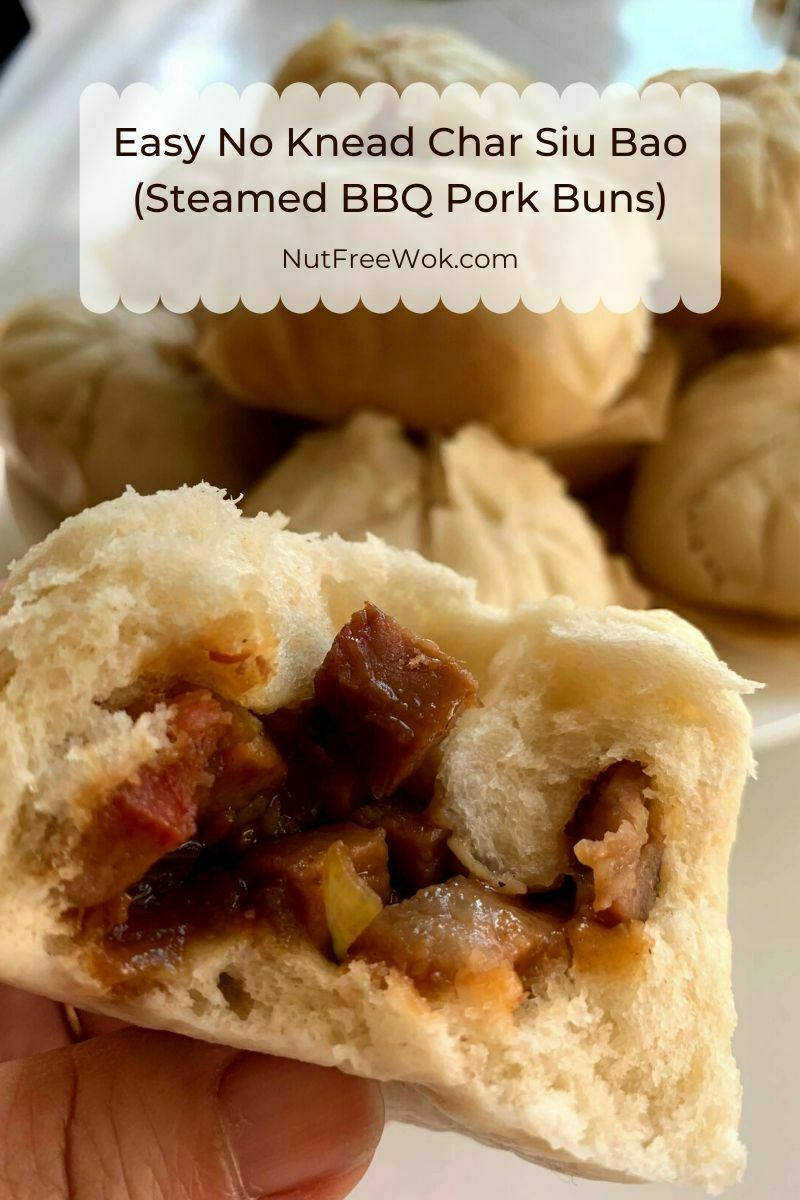
Baked Char Siu Baos are usually served as one of many small dishes at a dim sum meal. Instead of baked char siu baos, if you prefer steamed char siu baos, I have a fluffy, no-knead recipe that is easy to make with ingredients you probably have at home.
My absolute favorite dim sum dish are steamed rice noodle rolls, which are available filled with beef, shrimp, char siu, or dried shrimp. My sons love daikon cake (aka turnip cake), a steamed rice cake that is later sliced and pan-fried.
It’s a good idea to be healthy and eat some veggies with dim sum. Boiled gailan served with a drizzle of oyster sauce or on the side is the most common. I like stir fried pea shoots.
People also love dumplings such as potstickers. I think I need to make more dumplings, tell me in the comments which ones are your favorite.
Lastly, you might want to finish your meal with a dessert or two. Everyone’s favorite is an egg tart such as po tat. My mom’s favorite is a steamed brown cake called ma lai go.
There are two desserts that are increasingly harder to find anywhere (probably because they must be made and eaten on the same day) but are super easy to make. Consider trying to make Baak Tong Gou, a Top 9 Allergen Free Chinese Dessert and Easy Top 9 Allergen Free Banana Rolls Recipe.